.png)
Does Starbucks do background checks? If you've just applied for that green apron — or you're about to — it's the question quietly sitting behind every "we'll be in touch."
Here's the good news: this one has a clear answer.
Unlike a lot of "it depends" employers, Starbucks runs a consistent screening process. So instead of guessing, you can know exactly what's coming, when it happens, and what it actually looks at.
Let's pour a cup and get into it.
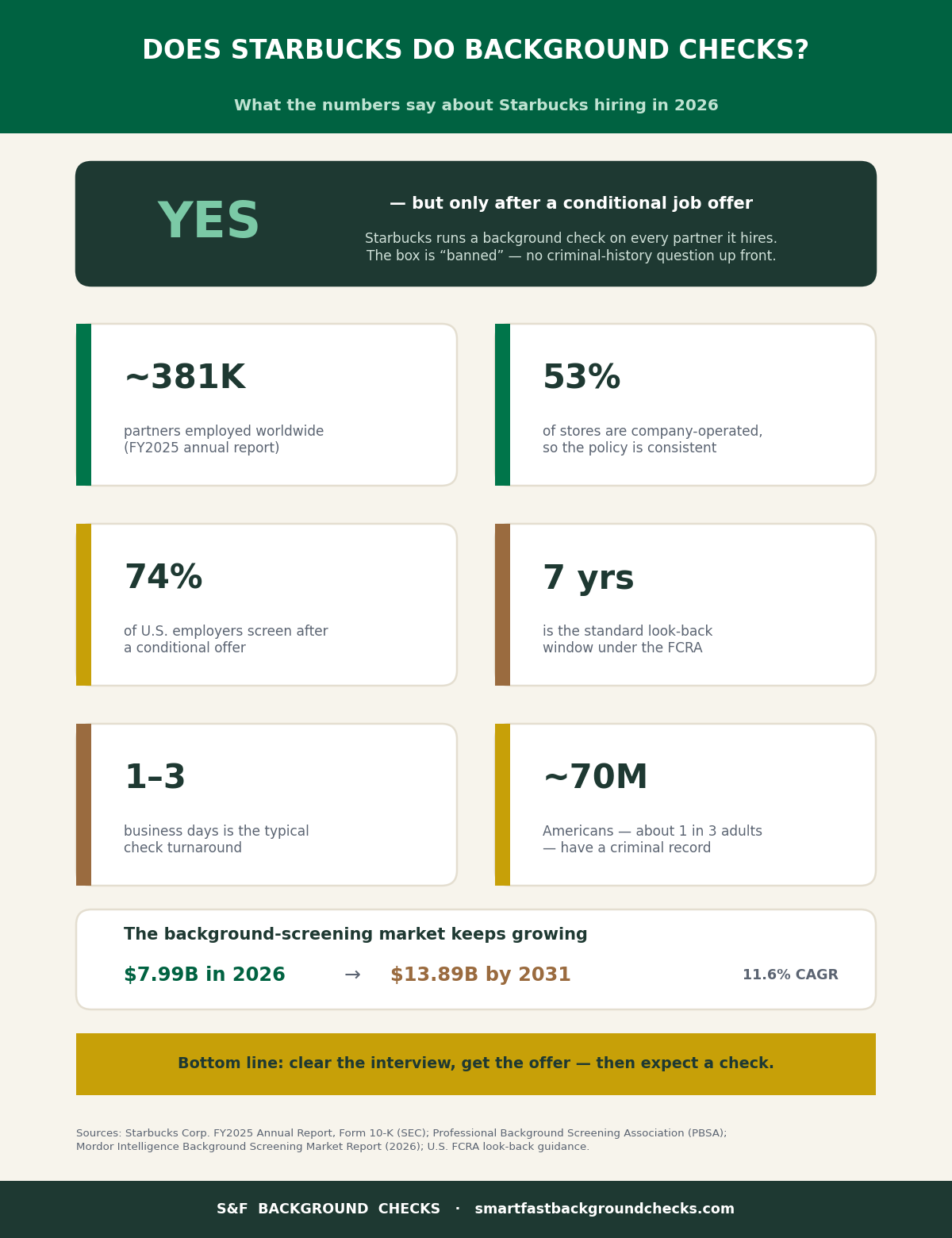
One number to frame the whole thing: as of its 2025 annual report, Starbucks employed roughly 381,000 people worldwide — about 223,000 of them in the United States. That's a lot of partners (Starbucks' word for employees), and nearly every one of them passed a background check to get there.
Short answer: yes — but with one important piece of timing.
Starbucks conducts a background check on essentially everyone it hires into a company-operated store, from baristas to shift supervisors to store managers, plus corporate roles. There's no "they skip entry-level" loophole. If you receive a job offer, a screening is part of the deal.
Here's the catch that trips people up.
Starbucks does not run that check the moment you apply. It waits until after it has made you a conditional job offer. In other words, you'll apply, interview, and get a "we'd like to hire you" first — and the background check comes after that, as the final step before your start date.
Why does that order matter so much? Because it means your record isn't judged before anyone has met you. More on that — and why it's genuinely in your favor — in a minute.
Sources: Starbucks Corp. FY2025 10-K (SEC); Professional Background Screening Association; Mordor Intelligence Background Screening Market Report (2026).
If you've read our other guides on big employers, you know the usual story: a brand "sometimes" checks because thousands of locations are independently franchised and each owner sets their own rules. Starbucks is different — and the difference is structural.
Most of the Starbucks you walk into is run by Starbucks itself. Of its roughly 40,990 stores worldwide, about 53% are company-operated; in the U.S., the company directly operates the large majority of its locations. Those stores follow one corporate hiring playbook — which is exactly why screening is so uniform.
The nuance worth knowing: the other slice of stores are licensed. Think of the Starbucks counter inside a Target, a grocery store, an airport terminal, or a college campus. Those are run by the licensee, not by Starbucks. So the "Starbucks" job inside a Target is technically a Target hire, and it follows that company's screening process — which may look a little different.
Bottom line? If you're applying at a standalone, company-operated Starbucks, expect the corporate process described here. If it's a kiosk inside another retailer, the host company's rules apply.
Timing again, because it's everything here. The check lands after your conditional offer — never on the initial application. Starbucks has "banned the box," meaning there's no checkbox asking about criminal history when you first apply.
And the front end of the process recently got tougher. As part of its 2025 turnaround, Starbucks added an extra interview layer for baristas, with leaders emphasizing that the brand wants only its strongest candidates to become partners. Translation: nail the conversation, because more eyes are on it than there were a couple of years ago.
Practically, that can mean a district manager joins the conversation — sometimes virtually — on top of the store manager's interview. It's a higher bar at the offer stage, but it doesn't change the screening that follows: the background check still waits until your conditional offer is in hand.
Want a feel for the questions before you walk in? This interview-prep video is a solid primer:
Now the real question: if they screen everyone, what shows up?
Good news for most applicants — a Starbucks check is closer to a standard retail screening than the deep-dive an investment bank runs on an executive. It's built to confirm you're safe and reliable for a fast-paced, customer-facing job. Here's the breakdown.
This is the heart of the check. A criminal search typically surfaces felony and misdemeanor convictions, generally going back about seven years under standard Fair Credit Reporting Act (FCRA) practice — and some states cap it shorter than that.
Whether a specific item appears depends on what it is. A dismissed, sealed, or expunged case is treated very differently from a recent conviction. We break the distinctions down in our guide on whether a charge shows up on a background check.
Two common worries deserve their own answers. If you have an old arrest that never led to a conviction, here's when an arrest will and won't show up. And if you have a case still moving through the courts, see whether pending charges show up on a background check — the rules vary by state.
Starbucks may confirm where you've worked and the dates you were there. For a first barista job, this is often light. For shift supervisor, store manager, and corporate roles, expect it to be more thorough — and expect any degree or credential you listed to be verified.
This part surprises people. Starbucks generally does not pull your credit report, even though many screeners offer it. So if your credit has taken a hit, that alone shouldn't stand between you and the apron. Driving records (MVRs) only come into play for roles that involve driving, and drug testing is not a standard hurdle for a typical barista hire. Here's the quick reference:
It's just as useful to know what won't surface. A standard barista screen doesn't comb through your browsing history, and while a manager might glance at public social media, that's an informal extra rather than part of the formal report. The focus stays narrow: identity, criminal record, and — for some roles — work history.
One more thing to know: if your report ever comes back flagged "consider" rather than "clear," that is not an automatic rejection. Here's exactly what "consider" means on a background check and the steps an employer has to follow next.
For a recruiter's-eye view of what a screening actually reveals — including how employment verification really works — this breakdown is worth a few minutes:
This is where the post-offer timing pays off — and where the news is genuinely encouraging.
Yes, Starbucks screens applicants with records the same as anyone else — but a felony is not an automatic disqualifier. Because Starbucks "bans the box," your criminal history doesn't even enter the conversation until after you've earned a conditional offer on your own merits. Then, if something surfaces, the company reviews it case by case.
What actually matters in that review? The nature and seriousness of the offense, how long ago it happened, and whether it's relevant to the job. A single old mistake and a recent serious offense don't land the same way. That's why "Do they hire felons?" isn't a clean yes-or-no — the details decide it.
Reality check, though: fair-chance does not mean no-check. Industry guidance is clear that the overwhelming majority of even the most second-chance-friendly employers still run a criminal screening. They simply commit to looking at your situation rather than auto-rejecting you.
So honesty is your best play. Once the offer is on the table and the topic comes up, be straightforward about your record. Getting caught omitting something does far more damage than the record itself.
The law is on your side here, too. The FCRA requires that before an employer can pull an offer based on your report, it must send you a pre-adverse-action notice along with a copy of the report and a summary of your rights — giving you a window to respond or dispute errors. Cornell Law School's Legal Information Institute has a plain-English overview of how the FCRA governs employment background checks if you want the legal backbone.
This first-hand walkthrough is a useful watch if you're applying soon — application, interview, and what the trial shift is really like:
Let's talk timeline, because the waiting is the part that frays nerves.
The background check itself is usually quick. Most retail-level screenings come back in about one to three business days once you've submitted your authorization and information. Simple database and county searches can clear in hours; anything requiring a manual court pull or a slow former employer can take longer.
Zoom out, though, and the whole journey — from application to first shift — tends to run about one to three weeks at Starbucks. The check is just one step near the end, after your conditional offer. If you've reached the screening stage, you're close.
For a full breakdown by check type and the exact bottlenecks to watch for, see how long background checks take for jobs.
A handful of things reliably slow things down. A common name that matches other records forces a manual review to confirm it isn't you. Some county courthouses still pull records by hand. Holidays freeze government offices. And a previous employer who won't return a verification call can stall things for days.
None of that is a rejection — it's just process. If a week goes by with silence, a polite check-in with the hiring manager is completely reasonable and often moves things along.

You can't control Starbucks' process. You can control how prepared you are. Two moves make the biggest difference.
This is the tip almost nobody uses. Before you apply, see what an employer will see. It lets you catch errors — a record that isn't yours, an outdated entry, a name mix-up — and start fixing them before they ever cost you a job. You can pull your own report through our personal background check and walk into the process knowing exactly what's on file.
It's inexpensive, and it removes the worst part of waiting: the unknown. If something inaccurate is sitting on your record, you'll have a paper trail ready the moment it comes up — instead of scrambling after an offer is already on the line. For a few dollars and a few minutes, you trade weeks of low-grade worry for certainty — and that calm tends to show in the interview itself.
We'll say it twice because it matters: when the topic comes up, disclose what you're asked to disclose. A record you owned up to reads as growth. A record they discover reads as deception. Managers forgive the first far more readily than the second.
Flip the counter for a second — maybe you run a cafe, a licensed location, or any hourly-heavy business and you're wondering how the pros do it.
Screening well isn't only about catching red flags. It's about negligent-hiring protection: if an employee causes harm and you never screened for a relevant risk, your business can be exposed. But screen carelessly — or in the wrong order — and you can run afoul of the FCRA or state fair-chance laws.
That balance is what a compliant, fast screening partner is for. A proper pre-employment background check keeps you on the right side of disclosure and adverse-action rules while still returning results fast enough that you don't lose good candidates to the shop down the street.
One more tip for operators: document your process. Ask about criminal history only at the stage the law allows, apply the same standard to every applicant, and keep a written reason for any adverse decision. Consistency is your best defense if a rejected applicant ever questions the call — and it makes for fairer hiring.
So — does Starbucks do background checks? Here's the honest recap.
Yes. Starbucks screens nearly everyone it hires into a company-operated store, and the policy is consistent because Starbucks runs most of its own locations. The check comes after a conditional offer, never on the initial application, because the company has banned the box. Expect a criminal search going back about seven years, possibly employment or education verification — and no credit check for a standard barista role.
A record, even a felony, isn't a wall. Starbucks reviews case by case, the law gives you real protections, and your interview is your leverage. Be honest, know what's on your report before they do, and the screening becomes a formality instead of a cliffhanger.
The applicants who stress the least are the ones who treat the background check as a step they've already prepared for — not a verdict they're sitting around waiting on.
Don't gamble your next job offer on a record you haven't seen. Order a fast, accurate background check today and walk into any interview a step ahead. Most reports are ready in 24–48 hours.
Fast turnaround · FCRA-compliant · No long forms