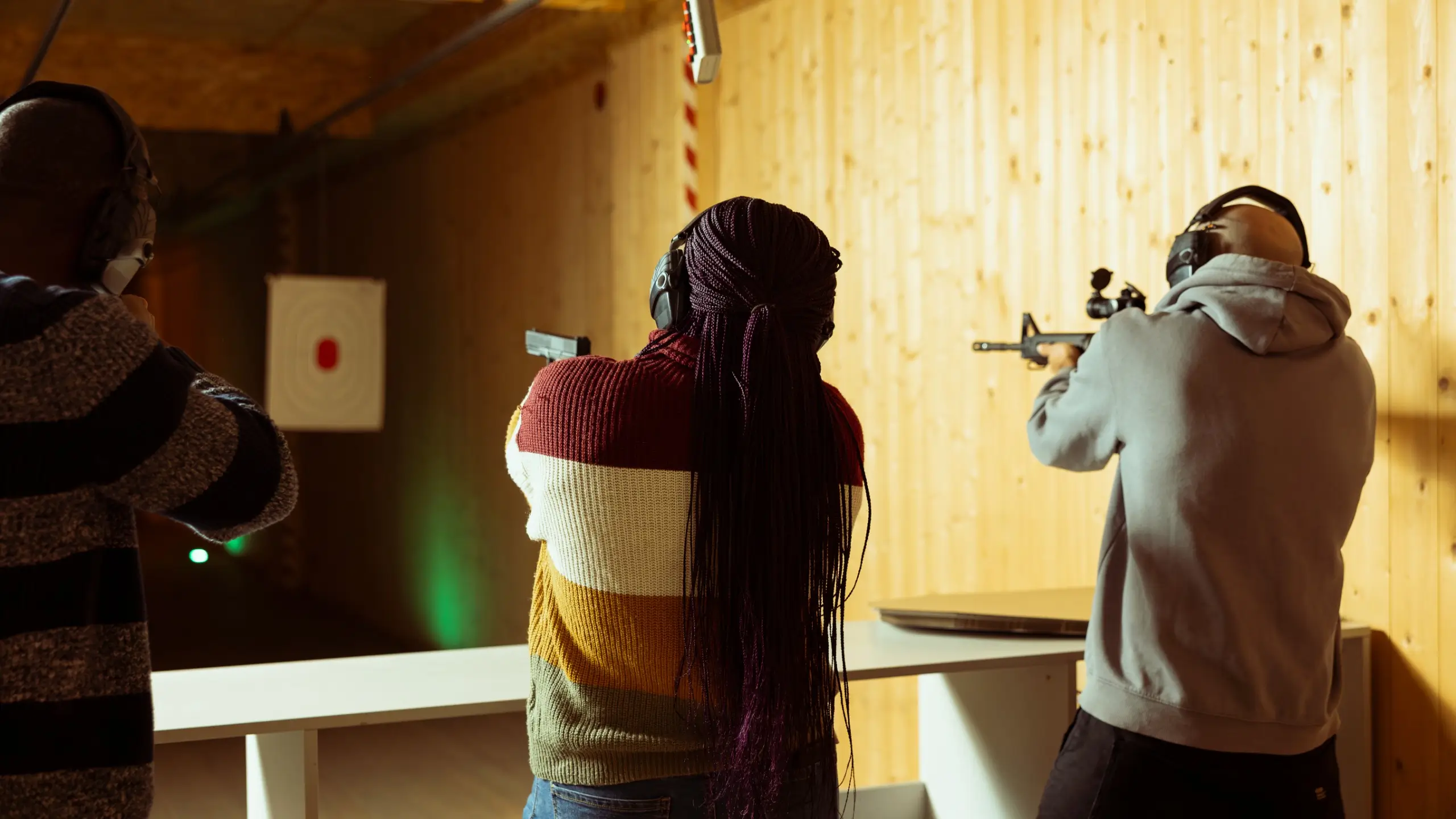
You walk into a gun range for the first time. You're handed a clipboard with a waiver, asked for your ID, and within ten minutes you're behind a rented pistol with live ammunition in your hands.
No fingerprints. No NICS check. No question asked about whether you're legally allowed to be there.
That's the reality at most American gun ranges — and it's one that surprises a lot of first-time shooters, worries some families, and continues to drive ongoing legal and legislative debate.
Do gun ranges do background checks? The honest answer is: usually no — but the full picture is more complicated than a yes or no. Federal law doesn't require it for range use or rentals. Some states layer on extra requirements. And some ranges run their own checks anyway, either as a matter of liability policy or because state law gives them latitude.
This guide breaks it all down. What the law actually requires, what individual ranges typically do, the state-by-state differences, what happens if you're a prohibited person, and how to know before you go.
Let's get the federal answer out of the way first, because it surprises most people.
Federal law does not require gun ranges to run background checks before you can shoot at the range or rent a firearm for use on the premises. The National Instant Criminal Background Check System (NICS) — the federal database operated by the FBI — is triggered by a firearm transfer from a licensed dealer to a buyer. Under 27 CFR § 478.102, the NICS check applies to permanent transfers, not on-premises rentals.
This distinction is the key to understanding why most ranges don't do background checks. When you rent a firearm and use it at the range, the gun never legally leaves the range's possession. The store maintains what's called "constructive possession" of the firearm — you're using it under their supervision, on their property, with their ammunition, and returning it before you leave. Because no transfer has occurred, federal law doesn't trigger a NICS requirement.
Bring your own legally owned firearm and ammunition to a range? Same answer. There's no transfer, no purchase, no federal trigger.
There are specific scenarios where federal law does require a background check at a range:
The first scenario is the most common. Many gun ranges are co-located with retail gun stores, and any purchase from a licensed dealer requires a NICS background check before the firearm can be transferred to you. The check itself takes a few minutes to several hours and pulls criminal history, mental health adjudications, restraining orders, and dishonorable discharges, among other categories.
Here's the part that often surprises people: federal law does prohibit certain individuals — felons, those with domestic violence convictions, people involuntarily committed for mental health reasons, those with active protective orders, and others — from possessing or handling firearms or ammunition at all. That includes at a gun range.
But the legal prohibition on possession does not translate into a federal requirement that gun ranges verify eligibility before letting someone shoot. The responsibility falls on the individual to follow the law. If a prohibited person rents a gun and uses it at a range, they have committed a federal offense — but the range has not necessarily broken any federal law by allowing it, provided they had no actual knowledge of the disqualification.
This gap between what the law prohibits and what it enforces is the heart of the ongoing debate. The video below from criminal defense attorney Carey York covers exactly how this plays out for someone with a felony conviction:
Some do. Most don't. Here's why the answer varies so much from one range to the next.
The vast majority of commercial shooting ranges require:
That waiver is doing a lot of legal work. By signing it, you affirm under penalty of perjury that you are legally allowed to handle a firearm. If you sign falsely, you've committed a separate crime — providing false information on a firearms-related document.
Some ranges go beyond ID and waivers. They may run a brief commercial background check, require proof of a concealed carry permit, demand membership applications with criminal history disclosures, or refuse rentals to first-time visitors who arrive alone.
These voluntary measures are not regulated by federal law. Ranges adopt them for three primary reasons:
The video below from the firearms industry channel Spike's Tactical walks through the reasoning behind range-level voluntary background check policies and how they differ from federal NICS:
Federal law sets the floor. State laws can — and often do — add requirements on top.
California. California requires background checks for ammunition purchases (with a narrow on-premises-use exception for ammunition consumed entirely at the range that day). The California Department of Justice runs these checks through a separate state system, not federal NICS. Range-only firearm rentals do not require background checks under California state law, but individual ranges often impose their own requirements. The state's ammunition background check law has faced legal challenges, with a federal judge ruling parts unconstitutional in 2024 — but the law remains in effect pending appeals.
Illinois. Illinois requires a Firearm Owner's Identification (FOID) card to handle firearms — even at a range. While the range itself may not run a background check at each visit, the FOID card you must present required a background check when it was issued. Out-of-state visitors face different rules and should confirm with the specific range before arrival.
New Jersey. Requires a Firearms Purchaser Identification Card (FPIC), which itself required a background check at issuance. Range rentals to non-residents and non-FPIC holders are subject to specific state rules.
Massachusetts. Requires a Firearms Identification card (FID) or License to Carry (LTC) — both of which involve background checks at issuance. Range operators verify these credentials, effectively building a state-administered background check into the access process.
In most other states — including Texas, Florida, Georgia, Arizona, and the majority of others — state law neither requires nor specifically regulates background checks for range use or on-premises firearm rentals. Range policies are entirely at the discretion of each facility.
This creates a patchwork that can confuse even experienced shooters who travel. The rules at a range in Texas may bear little resemblance to the rules at a range in Illinois.
For a clearer understanding of how state-level firearms laws and screening obligations interact with criminal histories, our breakdown of what charges show up on a background check is useful context — the same disqualifying records that affect employment screening also affect firearm eligibility under federal law.

This is where the legal exposure gets serious — and where most casual range visitors don't realize what's at stake.
Federal law under 18 U.S.C. § 922(g) makes it a crime for certain individuals to possess a firearm or ammunition. The key word is possess — not purchase, not transfer, just possess. The list of prohibited categories includes:
If you fall into any of these categories and you walk into a gun range, handle a rented firearm, or even touch ammunition, you have committed a federal offense. The penalties include up to 10 years in federal prison and substantial fines.
The Atlanta Journal-Constitution and Columbus Dispatch have both reported on cases where felons were arrested or charged after using shooting ranges. In one well-known incident, an ATF agent followed up on a convicted felon who had rented a firearm and purchased ammunition at a range — possession of the ammunition alone was enough to file federal charges. The range itself faced no liability, but the individual went to federal prison.
The shooting range did nothing illegal. It had no knowledge of the felony conviction. The waiver had been signed falsely. But the prohibited person took on real federal criminal exposure the moment they handled the firearm and ammunition.
This is why understanding what's on your record matters before you even consider visiting a range. If you have any uncertainty — a pending charge, an old felony you thought was sealed, a domestic violence misdemeanor you didn't realize counted — running a personal background check first is the responsible move. Our guide on what shows up in a background check walks through exactly what surfaces on a standard criminal history report so you know where you stand.
When a gun range does choose to run a check — whether for membership, rental policy, or specific concerns about a visitor — what are they actually looking at?
A voluntary range background check is not a NICS check. Ranges don't have access to the federal NICS system unless they're operating as a licensed FFL conducting a transfer. What they typically run is a commercial criminal background check that pulls from national criminal databases, state court records, and sex offender registries.
The kinds of records that surface include:
The range is generally most concerned with criminal convictions — particularly those that would make the customer federally prohibited. Civil records, credit history, and employment information are typically not part of a range-level screening.
If you're curious how rangers, dealers, and HR teams interpret the ambiguous results that often appear on commercial background checks, our breakdown of what "consider" means on a background check covers the gray-zone results that aren't a clean pass or fail.
The question of whether gun ranges should be required to run background checks comes up almost every legislative session somewhere in the country. The debate is driven by two specific concerns: prohibited persons gaining access to firearms, and the use of rented firearms in suicide cases.
According to a peer-reviewed study published by researchers at the Harvard T.H. Chan School of Public Health's Injury Control Research Center, approximately 35 suicides occur at public shooting ranges each year in the United States. The researchers analyzed 63,710 firearm suicides across 16 states from 2004 to 2015 and identified 118 that occurred at shooting ranges — roughly 0.18% of all firearm suicides.
The same study found that 86% of those suicides involved firearms rented from the range itself, and 88% of the decedents had arrived at the range alone. These findings prompted the researchers to recommend voluntary range policies — particularly refusing rentals to lone visitors — as targeted prevention strategies that would not require new federal regulation.
These numbers are the empirical backbone of the legislative debate. Legislation has been introduced in Virginia, Maryland, and other states to require background checks for firearm rentals at shooting ranges. None has passed into federal law as of 2026. The firearm industry's main trade group, the National Shooting Sports Foundation (NSSF), has argued that voluntary measures — refusing lone rentals, training staff in suicide warning signs, partnering with mental health resources — are more effective and less administratively burdensome than mandatory state-run check systems.
Source: Harvard T.H. Chan School of Public Health Injury Control Research Center; Hemenway et al., Crisis: The Journal of Crisis Intervention and Suicide Prevention, 2021
| Metric | Data Point |
|---|---|
| Average annual suicides at U.S. shooting ranges | ~35 per year |
| Percentage of all firearm suicides occurring at ranges | 0.18% |
| Percentage involving firearms rented from the range | 86% |
| Percentage of decedents who arrived alone | 88% |
| States currently requiring background checks for range rentals (federal) | 0 |
| Federal NICS checks required for on-premises range rentals | Not required |
| Federal NICS checks required for off-premises firearm transfers | Required |
This data underscores both the rarity of these incidents and the specific patterns that voluntary range policies have proven effective at addressing.

For the average law-abiding visitor, the question of background checks at a gun range is largely procedural. Here's what to actually expect at a typical commercial range.
That last document is important. Read it carefully. By signing it falsely, you commit a separate criminal offense entirely apart from possession. The waivers are written specifically to put the legal responsibility for eligibility on the customer.
Depending on the range, you may also encounter:
Different ranges enforce different combinations. Calling ahead — or checking the range's website FAQ — is the simplest way to avoid surprises at the door.
Do gun ranges do background checks before you can shoot? Generally no. Federal law does not require gun ranges to run background checks for on-premises firearm rentals or for visitors using their own firearms. Most ranges require only a valid ID, a signed liability waiver, and a self-disclosure that you are not a prohibited person. Some ranges voluntarily run additional screening, particularly for memberships.
Do gun ranges do background checks for rentals? Federal law does not require it. NICS checks are required only for firearm transfers from licensed dealers — not for on-premises rentals. State laws may impose additional requirements in California, Illinois, New Jersey, and Massachusetts, among others. Some individual ranges voluntarily screen rental customers as a liability measure.
Do gun ranges do background checks for buying ammo? Federal law does not require background checks for ammunition purchases. California has its own state-level ammunition background check requirement, with a narrow exception for ammunition used entirely on-premises at a range. Most other states have no such requirement.
Can a convicted felon legally go to a gun range? No. Under federal law (18 U.S.C. § 922(g)), convicted felons are prohibited from possessing firearms or ammunition. Going to a gun range and handling a rented or owned firearm constitutes possession and is a federal offense — even though the range itself may not be required to verify your status.
Do gun ranges check if you have a felony? Most do not run criminal background checks before allowing range use. They typically rely on the customer's signed waiver, which includes a disclosure that the customer is not a prohibited person. Signing this disclosure falsely is itself a federal offense.
Why don't gun ranges run NICS checks? NICS is structured to apply to permanent firearm transfers from federally licensed dealers, not on-premises rentals. Because the firearm never legally leaves the range's possession during a rental, no transfer occurs and NICS is not triggered. This is by design under federal firearms law.
Are there any states that require background checks for gun range rentals? As of 2026, no state requires a NICS-equivalent background check specifically for on-premises gun range rentals. Some states require state-level firearms credentials (FOID, FID, LTC, FPIC) that themselves involved background checks at issuance, which effectively creates a screening layer.
Will a pending charge stop me from going to the gun range? Pending charges generally do not prohibit firearm possession under federal law unless they involve specific categories such as domestic violence or an active protective order. However, if the charge results in a conviction, you may become a prohibited person retroactively. State law varies. For a full breakdown of how pending charges interact with background checks, see our guide on do pending charges show up on a background check.
Do gun ranges do background checks? In most cases, no — not in the federal NICS sense most people imagine. Federal law doesn't require it for range use or on-premises rentals, and most states haven't filled that gap.
But that doesn't mean the question is unimportant. Federal law still prohibits certain individuals from possessing firearms or ammunition, period. The legal responsibility falls on you. A range that doesn't run a check still relies on you to sign accurately and follow the law. Getting that wrong — even by accident — can mean federal charges.
The safest move, especially if you have any uncertainty about what's on your record, is to know what surfaces on a personal background check before you ever set foot in a range. Knowledge is the difference between a fun day of shooting and a federal headache that could have been avoided.
Whether you're a first-time shooter or a regular at the range, knowing what's on your background report keeps you on the right side of federal law. S&F Background Checks delivers fast, accurate personal background checks so you can confirm your eligibility before you sign that waiver.
Run Your Personal Background Check Now — Results in 24 Hours Don't take chances with federal firearms law. Confirm your record today and walk into any range with full confidence.