.webp)
Run a background check on the same person twice, and you can get two completely different answers.
One report comes back spotless. The other surfaces a felony. Same person. Same name. Same afternoon.
So which result is "right"?
Here's the twist: both of them. What shows up in a background check depends entirely on which check you run — which databases it pulls from, which counties it touches, how far back it looks, and who's running it. There is no single, universal "background check" that reveals everything about everyone. There are dozens of different checks, each with its own blind spots and strengths.
That matters more than most people realize. Roughly 1 in 3 American adults — somewhere between 70 and 100 million people — has some kind of criminal record on file, whether that's an arrest, a charge, or a conviction. Whether that record actually surfaces comes down to the kind of search someone runs.
This guide breaks it down by check type, so you'll know exactly what shows up, what gets missed, and why two reports on the same person can tell two different stories.
Let's start with the reframe that changes everything.
Forget the idea of "the" background check. It doesn't exist.
What people call a background check is really a bundle of separate searches, and an employer, landlord, or individual picks which ones to run. A quick instant search and a deep multi-county criminal screen are both "background checks" — but they return wildly different results.
Think of it like a medical scan. An X-ray, an MRI, and a blood panel all look at your body, but each one sees something the others can't. Run only the X-ray and you'll miss what the blood panel would have caught.
Background checks work the same way. So the real question isn't "what shows up in a background check?" It's "what shows up in this check?"
Let's walk through the main types, from the broadest and shallowest to the deepest and most accurate.
Most "instant" online checks run against a single, giant multi-jurisdictional database — the thing marketers love to call a "national criminal database."
Here's what shows up:
Sounds comprehensive. It isn't — and that's the catch most people never hear about.
The "national criminal database" is one of the most misleading terms in this entire industry.
It is not a single, official, government-run record of every crime in America. It's a privately compiled aggregate that stitches together roughly 2,200 to 2,800 separate sources — court records, departments of correction, and offender registries — totaling hundreds of millions of records. Impressive on paper. Incomplete in practice.
Why incomplete? Because many counties simply don't report into these databases, or report on a delay. A conviction entered at a county courthouse last month may not appear in the "national" database for weeks, months, or ever. And when something does appear, it's often missing the disposition — you might see that someone was arrested for theft, but not whether they were convicted, acquitted, or had the charge dropped.
That's why responsible screeners treat the national database as a pointer, not a verdict. A hit tells you where to look — it doesn't confirm what happened. The arrest-versus-conviction distinction is enormous, and we break it down in our guides on whether an arrest shows up on a background check and whether a charge shows up on a background check.
The takeaway? An instant database check is a great first pass. As a final answer, it's unreliable.
Criminal history doesn't live in one place. It lives across three layers — county, state, and federal — and what shows up depends on which layers a check actually touches.
This is the layer that matters most.
The vast majority of crimes are prosecuted at the county level, which makes the county courthouse the single most accurate and up-to-date source for criminal records. A county search shows convictions, pending cases, and case dispositions straight from the source — the precise details an aggregated database often lacks.
What shows up at the county level:
The limitation is geographic. A county search only covers that county. If someone lived in three states over the past decade, a single county search misses everything outside its borders — which is exactly why a thorough check uses a database search to find the right counties, then verifies each one directly.
Some states maintain a centralized criminal history repository that aggregates records from courts across the state.
What shows up: convictions and, in some states, arrests reported by agencies statewide. Coverage and reporting completeness vary dramatically from state to state — a strong repository in one state may be far more reliable than a patchy one next door.
Federal crimes — fraud, drug trafficking, embezzlement, federal weapons charges — don't appear in county or state searches at all. They live in the federal court system.
A federal check searches U.S. district court records, accessible to the public through PACER (Public Access to Court Electronic Records). One key point people miss: a federal check is not the same as a national check. National = a broad private database. Federal = actual federal court records. You need the federal layer to catch white-collar and federal criminal history that local searches never will.
An employment screen is where the most layers stack up — because hiring decisions carry the most risk.
A standard pre-employment package usually combines several searches into one report:
Depending on the role, employers may add more:
According to the University of Chicago's background check Q&A, a standard institutional check centers on criminal conviction history over roughly the past seven years, with credit and motor vehicle checks added only when the role specifically requires them — a good illustration of how employers tailor what shows up to the job itself.
For employers building this out, S&F's pre-employment background check and criminal background check cover the core layers in one report.
| Check Type | What Shows Up | Accuracy / Completeness | Typical Speed |
|---|---|---|---|
| Instant / "National" database | Broad criminal hits, sex offender status, possible arrests — often missing dispositions | Broad but shallow — not comprehensive; many counties don't report | Seconds |
| County criminal | Convictions, pending charges, and final dispositions from the source court | Most accurate — but only for that county | Hours to a few days |
| Statewide repository | Convictions (and some arrests) reported by agencies across the state | Varies widely by state | Minutes to days |
| Federal (PACER) | Federal crimes only — fraud, trafficking, embezzlement, federal charges | Authoritative for federal matters; misses state/local | Minutes to days |
| Employment package | Identity + criminal (all layers) + employment & education verification; sometimes credit, MVR, license, drug | Most complete when county-verified | 1–5 business days |
| Tenant / personal | Criminal, sex offender status, identity; tenant adds eviction & credit-based history | Scoped to purpose | Minutes |
Not every check is about hiring. Two of the most common non-employment checks are tenant screening and personal vetting.
A tenant background check focuses on whether someone is a safe, reliable renter. What typically shows up: criminal history, eviction records, and a credit-based look at payment history and outstanding debts. Landlords use these to make a defensible leasing decision — see S&F's tenant background check.
A personal background check — the kind an individual runs before a date, a roommate, a caregiver, or a business partner — usually centers on criminal records, sex offender registry status, and identity. It's lighter than an employment package but enough to catch real red flags. S&F's personal background check is built for exactly this.
Why does the package differ so much by purpose? Because the law and the stakes differ. A landlord weighing a lease and an individual vetting a first date don't need — or legally aren't entitled to — the same depth as an employer making a regulated hiring decision. The check is scoped to fit the question being asked, which is another reason "what shows up" never has a single answer.
The pattern holds across all of them: what shows up is defined by the purpose of the check.
Even on the same type of check, three factors quietly change what shows up.
Jurisdiction. Records only surface where you actually search. Miss a county, and you miss everything filed there. This is why address history is the backbone of a thorough check — it tells the screener where to look.
Time. Lookback windows limit how far back certain records can be reported. Many non-conviction records fall off after seven years under federal screening rules, and a growing number of states automatically seal or expunge older records after a waiting period. A record that showed up five years ago might not show up today.
Identity. This is the big one. Without a verified date of birth and Social Security number to anchor the search, name-only checks routinely attach the wrong person's record — or miss the right person's record filed under an alias or maiden name. There are a lot of John Smiths. Picture two people with the same common name, born a year apart, who once lived in the same metro area: a name-only search can easily blend their histories into a single, inaccurate report. A verified identity is what keeps one person's conviction from landing on another person's record.
Put those three factors together and you can see why the same "type" of check can still produce different results on different days, run by different providers. Accuracy isn't just about which search you choose — it's about how carefully that search is anchored and verified.
And the speed of the check matters too — instant database results are quick but shallow, while verified county searches take longer because a human confirms each hit. Our guide on how long background checks take covers realistic timelines by type.
A lot of background-check anxiety comes from believing checks reveal more than they do. Here are five things that, contrary to popular belief, generally do not show up.
Myth 1: "It shows my whole life." No. A check shows legally reportable, searchable records relevant to the package ordered — not a biography.
Myth 2: "Medical history shows up." It doesn't. Health records are protected by HIPAA and off-limits to employers.
Myth 3: "Sealed and expunged records still appear." Compliant screeners don't report records a court has sealed or expunged.
Myth 4: "Private social media shows up." Only publicly available content can be reviewed. Private accounts, DMs, and protected-class information are off-limits.
Myth 5: "Every check finds everything." As the entire first half of this article shows — no single check is comprehensive. What surfaces depends on the search.

The smartest move? Run a check on yourself before anyone else does.
A self-check shows you the same records an employer or landlord would see — criminal history, identity and address data, and any civil or financial records tied to your name. It's the fastest way to catch errors before they cost you a job or an apartment.
When you read it, watch for three things:
If something's wrong, you have the right to dispute it with the screening company before it follows you into a hiring decision.
The numbers make the case for checking carefully — and verifying what you find.
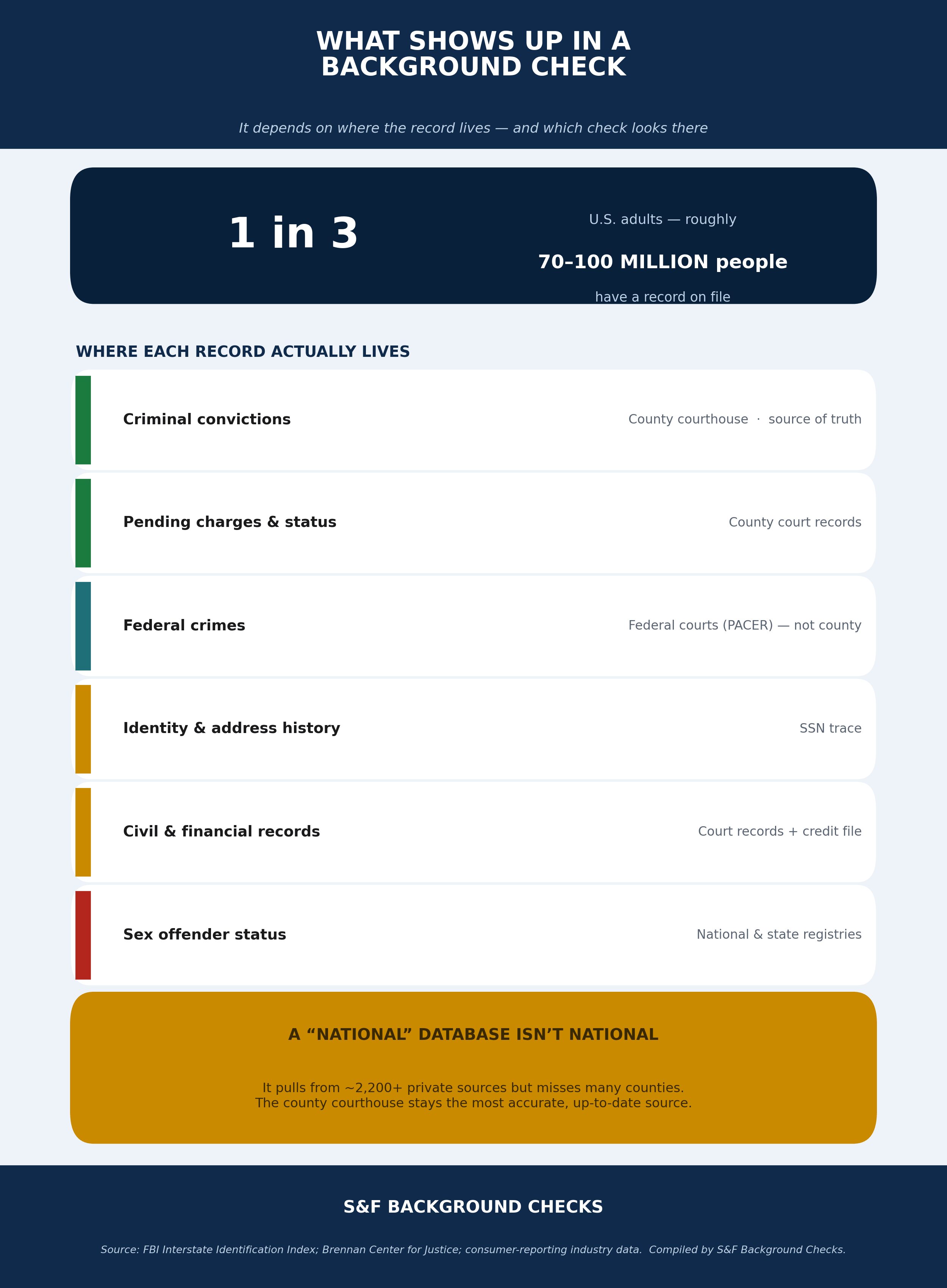
A few figures worth sitting with:
Read those together and the lesson is clear: a lot can show up — but only if the right check looks in the right place.
What shows up in a background check most of the time? For most checks, the core results are criminal records (felonies, misdemeanors, and sometimes pending charges), identity and address history, and — for employment — verification of work and education. Additional records like credit, driving, or licenses show up only when that specific search is included.
Does an arrest without a conviction show up? It can, depending on the state and the type of check, but many screens report only convictions. An arrest with no conviction is treated very differently under the law than a conviction.
How far back does a background check show? It varies by record type and state. Many non-conviction records fall off after seven years under federal screening rules, while convictions can often be reported longer. State sealing and expungement laws also affect what remains visible.
Why did two background checks on the same person show different results? Because they pulled from different sources. An instant national-database check and a verified multi-county criminal search look in different places — so they surface different records.
Does a background check show everything about a person? No. It shows legally reportable, searchable records relevant to the package ordered — not medical history, sealed records, private social media, or protected-class information.
Can I see what shows up on my own background check? Yes. Running a check on yourself shows the same records others would see, so you can catch and dispute errors before they affect a decision.
Here's the bottom line.
What shows up in a background check isn't fixed — it's a function of which check you run, where it looks, and how it's verified. An instant search might miss the record that matters. A shallow check might flag the wrong person entirely.
The fix is simple: run a check built to look in the right places, anchored to a verified identity, with results you can actually trust.
S&F Background Checks does exactly that — fast, accurate, and thorough, whether you're screening a hire, a tenant, or yourself.
Don't guess what's on the report. Know.