-2560x1440.webp)
Here's a number that should make you suspicious.
The exact same background check, on the exact same person, can cost anywhere from $0 to more than $500. Same name. Same records. Wildly different price tag.
So how much does a background check cost — really? And why is the range so absurdly wide?
The short version: there is no single price, because there's no single background check. What you pay is set by what you ask for — and that's actually good news, because it means you can dial the cost up or down to fit your situation. The trick is knowing which dials matter.
This guide breaks down the real numbers, the three levers that move the price, and the counterintuitive truth most buyers miss: the cheapest background check is often the most expensive one you can buy.
Let's start with the honest range.
No vague hand-waving — here are the numbers.
For an individual or a standard check, most people pay somewhere in the $20 to $100 range. Basic criminal searches sit at the low end. A more complete check that layers in verifications and multiple jurisdictions climbs toward $100 to $200. Highly specialized or international screening can push past $500.
To anchor that with a real-world example: even large institutions pay modest base prices. The University of Washington's core background check package runs about $33 per hire, with the cost rising only when a candidate's residency history requires extra county, state, or international searches.
And the free end of the spectrum is real but narrow. You can run a no-cost public-records skim, but it buys you a fraction of the picture — incomplete data, no identity verification, and nothing you can legally rely on for a hiring or tenant decision. In other words, the $0 option and the $200 option aren't the same product at different prices; they're different products entirely.
But an average doesn't help you budget your check. For that, you need to understand what actually moves the number — and it comes down to three levers.
Forget memorizing a dozen pricing factors. Almost every dollar of a background check's cost traces back to three things: Depth, Reach, and Speed. Move any one of them, and the price moves with it.
Here's how each lever works.
Depth is what you're searching, and it's the most controllable lever of all.
A background check is modular. Each search is its own line item with its own price, and the full report is just the sum of the parts you choose. Rough industry ranges look like this: a motor vehicle record runs about $10 to $20, a credit check around $10 to $20, and each employment or education verification roughly $15 to $50. Criminal searches form the base, and everything else stacks on top.
That's why a bare criminal search is cheap and a "check everything" package isn't — you're literally buying more searches. If you only need to know whether someone has a criminal or financial red flag, you don't have to pay to verify their college degree. (Curious which records actually surface, and where? See our guide on whether bankruptcies show up on background checks.)
Reach is where you're searching — and it's the lever most people never see coming.
Here's the part that surprises buyers: the single largest cost driver in many checks isn't the screening company's markup. It's the data-access fees that courts, agencies, and record vendors charge to pull a record. Search one county, and the cost is small. Search someone who's lived in five counties across three states, and each jurisdiction can carry its own fee.
Universities see this directly. The University of New Mexico's HR department publishes base background check rates but notes the final cost varies with the number of aliases and localities searched — and any fees those localities tack on. The more places a person has lived, the more the check costs to do right.
The takeaway: a low advertised price often assumes a single, simple jurisdiction. Reach is what turns a $30 quote into a $90 invoice.
Speed is the third lever — and in 2026, it's less of a premium than it used to be.
Traditionally, rushing results meant paying rush fees. Today, instant database checks return results in minutes at competitive prices, while deeper county-verified searches take longer because a human confirms each hit at the source. You're trading a little time for a little accuracy — and the right balance depends on your stakes. Our breakdown of how long background checks take maps the realistic timelines.
Put the three levers together and you get the typical price by check type. Rather than bury it in paragraphs, here's the quick-reference version.
| Check Type | Typical 2026 Price | What It Adds |
|---|---|---|
| Free public-records skim | $0 | Limited, unverified data — not legal for hiring or tenant decisions |
| Basic criminal check | $20–$50 | County criminal records + sex offender registry; identity basics |
| Standard check | $50–$100 | Multi-jurisdiction criminal, SSN/identity trace, address history, basic verification |
| Comprehensive check | $100–$200 | Adds federal search, credit, education/employment verification, licenses |
| Motor vehicle record (MVR) | $10–$20 | Add-on: violations, suspensions, DUIs for driving roles |
| Credit history (modified) | $10–$20 | Add-on: collections, liens, bankruptcies for finance-sensitive roles |
| Education / employment verification | $15–$50 each | Add-on: confirms degrees, dates, titles per institution/employer |
| International screening | $100–$300+ / country | Add-on: criminal/employment/education records abroad |
A few notes on reading that table:
Notice how the tiers map straight back to the three levers. An entry-level check is shallow Depth, narrow Reach, and instant Speed — so it's cheap. A standard check widens Reach (more jurisdictions) and adds a little Depth (identity plus a verification or two). A comprehensive check maxes out all three: many record types, every relevant jurisdiction, and human verification at the source. You're not paying a random premium as you move up — you're paying for measurably more searching.
Free checks exist, but "free" almost always means a public-records skim that misses records and can't legally be used for hiring or tenant decisions. We cover where free options make sense — and where they don't — in our companion piece on whether you have to pay for a background check.
And the package you need is tied to the decision you're making. For a quick personal vetting, S&F's personal background check covers the essentials; for hiring, a pre-employment background check stacks the layers an employer needs.
Now for the part nobody selling a $9.99 "instant report" wants you to read.
A bargain-bin background check can quietly become the most expensive line item you have. Here's how.
It matches the wrong person. Cheap, name-only searches routinely attach someone else's record to your subject — or miss your subject's record filed under an alias. The fix is re-running the check properly, so you pay twice. Worse, acting on a wrong-person record can blow up a hire or a lease.
It misses the records that matter. Many cut-rate checks run a single national database and stop. But that database isn't comprehensive — it leans on delayed, incomplete reporting, and the county courthouse is the real source of truth. A recent conviction can be sitting in a county the cheap check never touched. Knowing the difference between an arrest, a charge, and a conviction matters here too; see whether a charge shows up on a background check.
It skips compliance — and that's where the real money is lost. Budget checks often omit the compliance features that protect you. For employers, a non-compliant screening process isn't a minor risk: settlements in FCRA and negligent-hiring cases can reach well into six and seven figures. A few dollars "saved" on the check can become a half-million-dollar mistake.
"Free" isn't free. Free people-search sites frequently miss a large share of records and monetize your personal data instead of charging you. You pay with accuracy and privacy.
The lesson isn't "spend more." It's "spend right." A correctly scoped, verified check costs a little more up front and saves you from paying for the same answer twice.

Even past the sticker price, watch for the extras that turn a cheap check expensive:
A transparent, all-in price almost always beats a low headline number with surprises attached.
The right budget isn't "as little as possible." It's "enough for the stakes."
Use a simple rule: the more a wrong decision would cost you, the more the check is worth. Here's how that plays out.
Low stakes — a quick personal vetting. Meeting someone, screening a casual acquaintance, or satisfying basic peace of mind? A basic criminal and identity check at the low end of the range is plenty. Spending more here mostly buys reassurance you don't need.
Medium stakes — a tenant or a standard hire. Renting your property or filling a typical role? You want criminal coverage across the right jurisdictions plus identity verification — a mid-tier check that won't leave obvious gaps. This is the tier most employers and landlords should default to, because the cost of missing a real record starts to bite.
High stakes — money, keys, or vulnerable people. Hiring for a role with financial access, handing over keys, or trusting someone around children or elderly clients? This is where a comprehensive, verified check earns every dollar. The downside risk dwarfs the price, and skimping is the false economy that gets organizations sued. (Not sure how to read a flagged result before you act on it? Our guide on what "consider" means on a background check walks through it.)
To see why that math favors spending appropriately, look at what a wrong call actually costs.
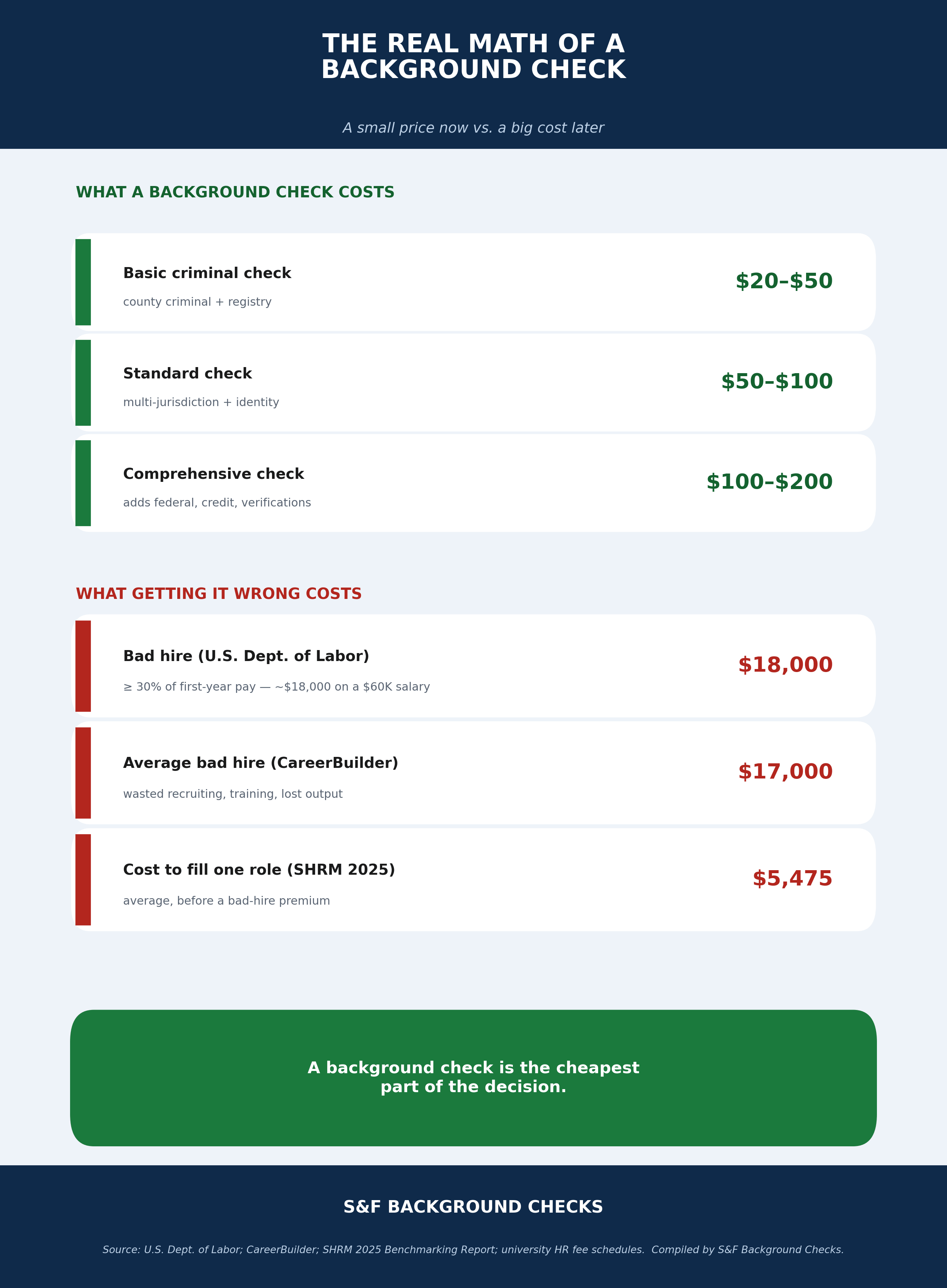
The numbers are sobering. The U.S. Department of Labor estimates a single bad hire costs at least 30% of that person's first-year earnings — roughly $18,000 on a $60,000 salary, and up to 50% for managerial roles. CareerBuilder puts the average bad-hire cost around $17,000, and SHRM's 2025 benchmarking pegs the average cost to fill a role at $5,475. Set any of those against a check that costs a few dollars to a couple hundred, and the value is obvious.
A background check isn't really an expense. It's cheap insurance against a very expensive mistake.
Spending right doesn't mean overspending. A few moves cut the price without cutting the coverage you actually need.
Run a self-check first. Reviewing your own report before an employer does lets you catch and fix errors so you're not paying to re-run a flagged check later. It also shows you exactly what others will see.
Give accurate address history up front. Since Reach drives cost, an accurate list of where someone has lived helps a screener search exactly the right jurisdictions — no wasted searches, no missed ones.
Bundle instead of buying à la carte. If you need several searches, a package usually beats paying per component. And if you screen regularly, volume pricing brings the per-check cost down.
One-off checks always cost more per report than checks run in volume.
A single personal or tenant check is priced as a standalone. But employers screening regularly can access volume rates that drop the per-check cost meaningfully. If you're a landlord or a small business running checks every month, ask about bulk pricing rather than paying retail each time. For individuals, S&F's affordable background checks keep one-off costs low without sacrificing accuracy.
Pull the threads together and the picture is clear.
A typical check costs little — anywhere from free to a few hundred dollars depending on Depth, Reach, and Speed. The cost of getting a major decision wrong is measured in the thousands to hundreds of thousands. Even institutions that screen at scale pay modest per-check prices, and they still consider it non-negotiable.
The question was never really "how much does a background check cost?" It's "how much is the right answer worth to me?" For almost every situation that matters, the check is the cheapest part of the decision.
How much does a background check cost for employment? Standard employment checks typically run $20 to $100 per candidate, with comprehensive packages (adding verifications and federal searches) reaching $100 to $200. The exact price depends on how many record types and jurisdictions are searched, plus any volume discount.
How much does a background check cost for an individual? A personal or self-check usually costs between $20 and $50 for the basics, more if you add verifications. Running one on yourself is the cheapest way to see what others will see and fix errors early.
Why do background check prices vary so much? Three levers: Depth (how many record types), Reach (how many jurisdictions, including court/agency access fees), and Speed (instant vs. verified). Change any one and the price changes.
Are free background checks worth it? For casual curiosity, maybe. For real decisions, no — free checks miss records, aren't verified, and can't legally be used for hiring or tenant screening.
Is a cheaper background check a good deal? Not always. Cheap, name-only checks can match the wrong person or miss records, forcing a re-run and creating legal exposure — so the "deal" can end up costing far more.
How much does a background check cost for renting an apartment? Tenant screening typically runs $20 to $50 per applicant and usually covers criminal history, eviction records, and sometimes a credit-based look. Many landlords pass this cost to applicants as part of the application fee, and those who screen often can lower the per-check price with volume rates.
How can I lower the cost of a background check? Match the check to the risk, provide accurate address history, bundle searches instead of buying à la carte, and use volume pricing if you screen regularly.
Here's the bottom line.
How much a background check costs is entirely in your control: a few dollars for a quick check, a bit more for a thorough one. What's not in your control is the cost of a bad decision made without one — and that bill runs into the thousands.
So don't shop on price alone. Shop on value: an accurate, verified, fairly priced check that gives you the right answer the first time.
S&F Background Checks delivers exactly that — fast, accurate, and affordable, with no surprise fees.
Don't guess. Don't overpay. Just know.