.webp)
You hit submit. Then… nothing.
The form's done, the consent is signed, and now you're refreshing your inbox every twenty minutes wondering if something's gone wrong. A job, an apartment, a gun purchase, a volunteer spot — whatever you're waiting on, the silence is the worst part.
So how long does a background check take, really? And here's the irony worth sitting with: the system that runs your firearm check is literally called the National Instant Criminal Background Check System — yet some of those checks still take three days. "Instant" clearly has an asterisk.
The honest answer is that a background check isn't one clock ticking. It's a stack of separate searches running at very different speeds, and your total wait is set by the slowest one. Most of the work finishes in seconds. The wait you feel is almost always a single piece that needs a human.
This guide pulls back the curtain: what's actually happening while you wait, how long each kind of check really takes, and how to tell whether yours is moving normally or genuinely stuck.
Let's start with the part nobody explains.
Here's the reframe that makes everything click: a background check runs at two speeds at once.
Speed one is instant. Identity and Social Security number traces, national database scans, sex offender registry checks, driving records, and credit pulls all hit digital databases and come back in seconds to minutes. If your check were only these, you'd have results before you finished your coffee.
Speed two is human. County court verification, employment confirmation, and education checks depend on a person on the other end — a clerk pulling a file, an old employer returning a call, a registrar confirming a degree. These move on someone else's schedule, not the software's.
That's why a single report can be "90% done" in minutes and still take days. The fast pieces are waiting on the one slow piece. Understanding which speed your check is running explains nearly every wait you'll ever experience.
It also tells you what to expect before you even start. If your check is database-only — a basic criminal and identity scan — plan for minutes. The moment you add anything that needs a human to confirm it — a county record, a past job, a degree — you've moved into "speed two," and the timeline shifts from minutes to days. Knowing that in advance turns an anxious wait into a predictable one.
So what's happening during that wait? Let's watch it unfold.
A background check feels like a black box. It isn't. Here's the play-by-play.
The instant you submit, the first job is confirming you are who you say you are.
An SSN trace validates your number, surfaces any aliases or former names, and — crucially — builds an address history. That address history is the map for everything next: it tells the system which counties and states to search. This step is near-instant, but if your name, birthdate, and SSN don't line up cleanly, the whole process pauses right here until it's sorted.
Next, the digital searches fire off more or less simultaneously.
National criminal databases, the sex offender registry, driving records, and (if requested) a credit pull all return fast because the data is already digitized. For a basic personal or tenant check, this is often the entire job — which is why those can finish in minutes.
This is also the stage that creates the illusion of speed. You may get a near-instant "preliminary" view that looks complete, only to wait days for the verified version. The instant scan is broad but shallow; it flags where to look, not what the final answer is. The difference between that first glimpse and the finished report is the verification still happening in the background.
Then comes the wait you actually feel.
A national database is a starting point, not the final word — any potential hit has to be confirmed at the source, which usually means a county courthouse. Some counties return records online in minutes; others still require a researcher to physically pull a file. Layer in employment and education verification — which depend entirely on third parties answering — and you've found your bottleneck. The county or the unresponsive former employer is almost always the thing standing between you and "complete."
Picture a typical example: a candidate's identity clears in seconds, the national scan and driving record come back within the hour, but one former employer's HR line goes to voicemail for two days. Nine of ten components are finished — yet the report still reads "in progress," because the rule is simple and unforgiving: the report isn't done until the slowest piece is done.
If a record does surface, it may need review before anyone acts on it — a flag isn't a rejection. We explain that distinction in what "consider" means on a background check, and what a recent court record can do to timing in whether pending charges show up on a background check.
Here's where most guides go wrong: they answer for jobs only. But the reason you're waiting changes the timeline completely. A check run before a gun purchase, an apartment lease, a volunteer shift, and a federal job all pull from different systems and follow different rules — so they finish on wildly different clocks. Here's the real picture by purpose.
A standard employment check typically clears in 2 to 5 business days — fast on the database side, slowed by any verification. We go deep on hiring timelines, delays, and exactly when to follow up in our dedicated guide on how long background checks take for jobs. Universities make good real-world benchmarks here: George Mason University reports an average vendor turnaround of about 1.8 days, while Columbia University — which runs a two-part check under New York City's Fair Chance Act — averages closer to 10 business days. Same type of check, very different clocks, depending on the rules and jurisdictions involved.
Tenant screening is usually one of the fastest checks there is.
Because it leans on instant databases — criminal, eviction, and a credit-based look — many landlords get results in minutes to a single business day. The wait only stretches if the applicant has lived in jurisdictions that require manual record retrieval. For a high-volume landlord screening a stack of applicants, that speed is the difference between filling a unit this week and losing a good tenant to a faster competitor.
This is the "instant" check with the famous asterisk.
When a licensed dealer submits your information to the FBI's NICS system, the vast majority of checks return a "proceed" or "deny" within minutes. But if your details match a potentially prohibiting record, you get a "delayed" status while the FBI digs deeper. By law, the FBI has three business days to resolve it; if it can't, the dealer may (in most states) proceed with the sale. Some states add their own waiting rules on top. For the full picture of who checks what at the counter, see our guide on whether gun ranges do background checks.
Need an official FBI Identity History Summary — for licensing, immigration, or working abroad? Timing depends entirely on how you submit.
Submitted electronically, results commonly land in about 3 to 5 business days after the FBI receives your fingerprints; FBI-approved channelers can be faster still, sometimes within 24 to 48 hours. Mail in a paper fingerprint card instead and you're looking at 2 to 4 weeks or more. (A full FBI background investigation for a security clearance is a different animal entirely — that can run 12 to 14 weeks.)
The gap between "a couple of days" and "a few weeks" comes down almost entirely to the submission method. Electronic Live Scan prints reach the FBI in seconds and skip the mailroom; a physical card has to travel, get scanned, and join a queue. If timing matters, the method you choose at the fingerprinting counter matters more than anything the FBI does afterward.
These usually ride on a criminal search plus, often, fingerprinting — so they range from a couple of business days to a couple of weeks, depending on whether prints go in electronically or by mail and how busy the relevant board is. Roles that work with children or vulnerable adults frequently require this extra fingerprint step, which is the main reason a volunteer check can take longer than a quick personal one even though it covers similar ground.
A self-check is typically among the quickest, since it focuses on instant criminal and identity data — often minutes. It's also the smartest pre-emptive move: see what an employer or landlord will see, and fix any errors before they cost you. S&F's personal background check is built for exactly that.
| Purpose / Check Type | Typical Time | Why |
|---|---|---|
| Personal / self-check | Minutes | Runs on instant criminal & identity databases |
| Tenant screening | Minutes–1 business day | Instant databases; manual counties add time |
| Standard employment | 2–5 business days | Database parts are instant; verification at the source is the wait |
| Comprehensive employment | 5+ business days | Adds education, employment & international verification |
| Gun purchase (NICS) | Instant — up to 3 business days | Usually instant; a "delayed" status gives the FBI up to 3 days |
| FBI fingerprint (electronic) | ~3–5 business days | After the FBI receives prints; channelers can be 24–48 hrs |
| FBI fingerprint (by mail) | 2–4 weeks | Postal delivery + manual processing |
| Security-clearance investigation | 12–14 weeks | A full FBI investigation — not a database check |

The hardest part of waiting is not knowing whether to be patient or worried. Here's how to tell the difference.
This is almost certainly normal if:
It may genuinely be stalled if:
The honest truth? Most "stuck" checks aren't stuck — they're waiting on one slow human link in the chain. The fix is usually a nudge, not a panic. A polite status request after three business days is completely reasonable, and a good provider can tell you exactly which component is still open — which beats guessing every time your inbox pings.
You can't control the courthouse. But you can eliminate the delays that are within reach.
Get your details right the first time. A transposed SSN digit, a missing middle name, or a misremembered former address forces the search to pause and re-verify. Accuracy up front is the single biggest time-saver.
Respond instantly to any request. If the provider or employer asks for clarification, every hour you take is an hour added to the total. Reply the same day.
Give your references a heads-up. A quick text to former employers and schools letting them know a verification is coming can shave days off the slowest step.
Choose a fast, modern provider. The technology behind the check matters enormously — providers with automated court access and real-time tracking finish far faster than those relying on manual queues. A fast background check built for speed returns the instant pieces immediately and chases the slow ones in the background. The right provider doesn't just run faster — it tells you where things stand, so you're never left wondering whether to wait or follow up.
Mind the calendar. Starting a check early in the week — and away from holidays — avoids dead days when offices are closed.
Put the numbers side by side and the "two-speed" reality jumps out.
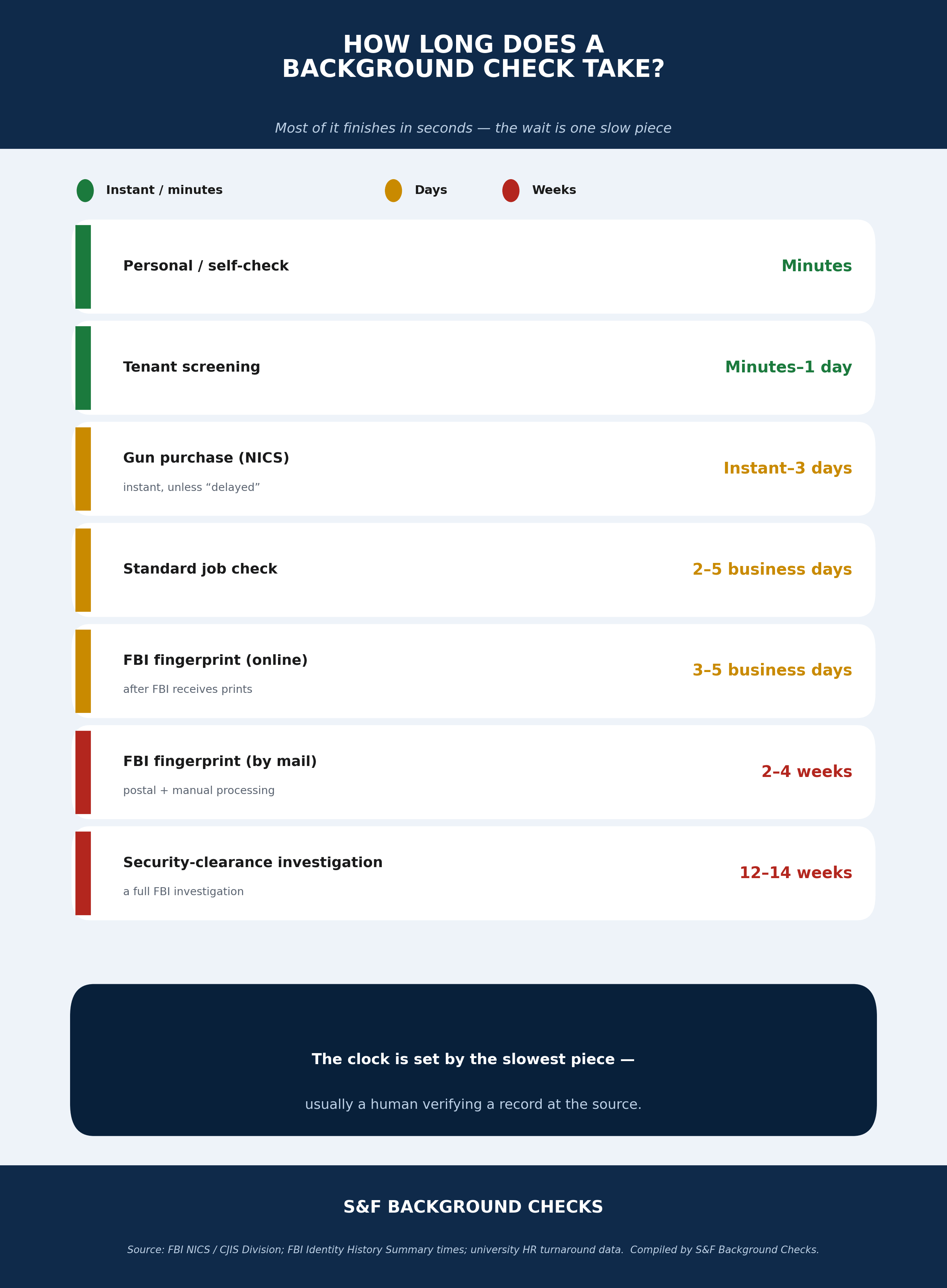
A few figures worth remembering:
The pattern is consistent: the digital pieces are nearly instant, and the wait is whatever single step needs a human at the source.
How long does a background check take on average? For a standard check, one to three business days is typical, stretching to five or more if employment, education, or international verification is involved. Instant database-only checks finish in minutes.
Why is my background check taking so long? Almost always one slow component — a county that requires manual record retrieval, an unresponsive former employer, a multi-state address history, or a weekend/holiday closure. The rest of the report is usually already done.
How long does a gun background check take? NICS checks are usually instant. If you get a "delayed" status, the FBI has up to three business days to resolve it; some states add their own waiting period.
How long does an FBI background check take? An online Identity History Summary typically takes about 3–5 business days after fingerprints are received; channelers can be faster, while mail-in requests take 2–4 weeks. A full clearance investigation can take 12–14 weeks.
Does a background check take longer on weekends? Effectively, yes. Courts, schools, and agencies are closed on weekends and holidays, so a check started Friday often won't progress until the next business day.
How can I speed up my background check? Provide accurate information up front, respond immediately to any requests, give former employers a heads-up, and choose a provider built for fast turnaround.
Here's the bottom line.
How long a background check takes comes down to one thing: how quickly the slowest piece clears. The instant data is already there. The wait is the verification — and the right provider makes that verification fast without cutting corners on accuracy.
S&F Background Checks returns the instant results immediately and chases the rest the moment it's available — so you spend less time refreshing and more time deciding.
Don't wait in the dark. Get moving.