.webp)
Strangers have read your record. You probably never have.
Think about that for a second. Employers, landlords, licensing boards, and lenders have all pulled reports on people — and somewhere in a database is a file with your name on it that they could pull too. Yet most people have never once looked at their own.
That gap matters more than ever, because the data behind those reports is wrong a lot. The single most common complaint Americans file with the Consumer Financial Protection Bureau about their own consumer records isn't fraud or identity theft — it's that the information is simply incorrect. In 2024, complaints about incorrect information on reports surged, and disputes about background-screening-type reports climbed right alongside them.
So learning how to run a background check on myself isn't about paranoia. It's about seeing what everyone else can already see — and fixing it before it costs you a job, an apartment, or a license.
This guide does more than tell you to "run it and review." It teaches you to read your own report the way a professional screener does, decide what's a real problem versus a harmless blip, and fix whatever you find — whether it's an error or an accurate record you'd rather not carry.
Let's get you that report first.
Here's the uncomfortable asymmetry: the first time most people see their own background report is after it's already cost them something.
A job offer that quietly evaporates. A rental application "we decided to go another direction." You rarely get told the real reason — and the real reason is sometimes a record that isn't even yours.
Running your own check flips that script. Instead of being the last to know, you become the first. You walk into the application already knowing what they'll find, with time to correct an error or get ahead of a real record on your own terms. That head start is the entire point.
Consider how often the surprise is avoidable. Someone applies for an apartment, gets denied, and assumes the market is just competitive — when in fact a stranger's eviction record got attached to their name through a database mix-up. They never find out, so they never fix it, and it follows them to the next application and the one after that. A ten-minute self-check would have surfaced it the first time. The cost of not looking compounds quietly; the cost of looking is a few minutes.
Good news: the mechanics are simple. The whole job comes down to three moves.
One: gather your identifiers. Pull together your full legal name (and any former names or maiden names), date of birth, Social Security number, and a list of every place you've lived. That address history matters — it determines which jurisdictions a thorough check will search.
Two: pull your report. You have two routes here, which we'll compare in a second.
Three: get it in hand and read it. That last step — actually reading and understanding the report — is where the real value lives, and it's where most guides leave you hanging. We won't. A report you skim and file away does nothing; a report you actually understand is what lets you fix an error or prepare for a hard conversation. Treat the document as the beginning of the process, not the end of it.
You can do this the slow way or the fast way.
Free / DIY: You can request your own criminal history from your state's repository, search county court records where you've lived, and check the national sex offender registry — all at no cost beyond your time. The catch is the same one investigators face: records are scattered across jurisdictions, and stitching them together yourself is tedious and easy to get wrong.
Professional self-check: A consumer reporting agency pulls national, state, and county data at once and anchors it to your verified identity — so you see, in minutes, roughly what an employer or landlord would. S&F's personal background check is built for exactly this, and an affordable background check keeps a self-audit cheap enough to repeat.
One reassurance: running a check on yourself is a personal records request. It doesn't notify anyone, doesn't appear as an employer inquiry, and doesn't touch your credit score.
Here's the skill nobody teaches: a background report isn't a verdict, it's a document — and reading it correctly is half the battle. A professional screener doesn't panic at the first entry. They read each section with specific questions in mind. Do the same.
Start at the top, not with the scary stuff.
Confirm that the name, date of birth, and address history all match you — exactly. This is where the most damaging errors hide. If a record is attached to someone who merely shares your name, the whole report is compromised. Federal regulators have found that screeners sometimes fail to match public records to the right person, attaching one person's criminal history to another's report. So before you react to anything below, make sure it's even about you.
Why does this happen so often? Common names, missing middle names, and recycled or mistyped Social Security numbers all create overlap, and some databases merge records on thin matching criteria. The fix starts with noticing — if a date of birth is off by a year, or an address belongs to a city you've never set foot in, that's your first clue the record isn't yours, not a reason to panic.
Now the part people dread — read it precisely.
A charge is not a conviction. A dismissed case is not a conviction. An arrest with no conviction is treated very differently under the law than a guilty verdict. These distinctions decide whether something can legally affect a decision at all, so don't lump them together. Our guides break each down: whether a charge shows up on a background check, whether an arrest shows up, and whether pending charges show up. Read your criminal section with those categories in mind, and a lot of "scary" entries turn out to be far less serious than they first look.
If you're looking at a report formatted the way an employer's vendor produces one, you may see a status like "consider" or "review" rather than a clean pass or fail.
Don't read that as a rejection. It means something was flagged for a human to look at — nothing more. We explain exactly what triggers it and what it does (and doesn't) mean in what "consider" means on a background check.
Finally, scan the financial and address data.
Depending on the report, you may see bankruptcies, liens, or judgments — relevant mostly for rentals and finance roles (here's how bankruptcies show up). Check that none of it belongs to someone else, and that your address history doesn't include places you've never lived — a classic sign that a similar-name record got mixed into your file.

Not everything on a report is a crisis. The skill is sorting what you find into three buckets — because each one gets a completely different response.
Bucket 1: It's an error. A record that isn't yours, a dismissed case shown as open, a misdemeanor inflated to a felony, an expunged record that resurfaced. These are fixable, and you have a legal right to fix them.
Bucket 2: It's accurate but old or minor. Many non-conviction records and older items legally fall off after a set period. Under federal reporting rules, each negative item carries its own clock — a criminal charge that didn't lead to a conviction generally can't be reported beyond seven years from the charge. Something accurate may not even be reportable anymore.
Bucket 3: It's accurate, recent, and real. This is the one people avoid thinking about — but it has a playbook too, and avoiding it is the worst option.
Sort first, then act. Here's how to handle each.
| What You See | What It Might Mean | What To Do |
|---|---|---|
| A record that isn't yours | Wrong-person match or database mix-up (common with shared names) | Dispute it — provide ID proving the record isn't you |
| A dismissed case shown as "open" or "pending" | Court database wasn't updated when the case resolved | Dispute it — attach the court dismissal paperwork |
| A misdemeanor listed as a felony | Miscategorized record | Dispute it — show court records with the correct level |
| An old charge (no conviction) past 7 years | Outdated — likely beyond its reporting window | Dispute it as non-reportable |
| An expunged or sealed record still showing | Database not refreshed after the court order | Dispute it — attach proof of expungement/sealing |
| A "consider" or "review" flag | Flagged for a human to review — not a rejection | Read the context; prepare to explain if it's accurate |
| An accurate, recent conviction | Real and reportable | Prepare a brief, honest explanation; explore expungement/sealing |
| Wrong address or alias in the identity block | A similar-name record may be mixing into your file | Verify and dispute the mismatched identity data |
This is where running your own check pays off — because finding a problem is only useful if you know what to do next.
You have real leverage here, and the law is on your side.
Under the Fair Credit Reporting Act, you can dispute inaccurate information, and the reporting agency must investigate — typically within 30 days — and correct or remove anything it can't verify. This isn't a long shot, either: in one federal enforcement review, nearly 70% of criminal-history disputes consumers filed with a major screener resulted in some change or correction to the report. Document the error, gather proof (court dismissal paperwork, proof of expungement, an ID showing the record isn't yours), and submit a formal dispute. If a company stonewalls, you can escalate a complaint to the CFPB.
Before you stress over an old entry, check whether it's even reportable.
Each item has its own reporting window, and many older, non-conviction records simply age off. If something looks like it's overstayed its legal welcome — an old charge with no conviction lingering well past seven years — that's not something you have to live with. It's something you can dispute as non-reportable.
If a record is accurate, recent, and reportable, you have two honest paths — and both beat pretending it isn't there.
Prepare to address it. Decide how you'll explain it briefly and without defensiveness: what happened, what's changed, what you've done since. Employers are bound by individualized-assessment guidance that weighs the nature of an offense, how long ago it was, and its relevance to the role — so context genuinely matters. A short, honest, forward-looking explanation almost always lands better than a record that surfaces with no warning and looks like something you tried to hide.
Look into clearing it. Many records are eligible for expungement or sealing, and a growing number of "Clean Slate" laws expand that eligibility every year. The University of Akron's law library explains the difference clearly: expungement can destroy a record, while sealing keeps it on file but hides it from public view. University law school clinics around the country offer free help petitioning for both. Clearing a record is a legal, legitimate fresh start — not a way to hide anything.
Once is good. A habit is better.
A self-check isn't a one-time event — your record can change, and so can the databases that store it. Run one before any high-stakes moment: a job hunt, a lease, a professional license, a volunteer role with a fingerprint requirement, or a security clearance. Run one after a move across state lines, since criminal searches are jurisdiction-specific. And run one if you've ever been a victim of identity theft, since fraud can attach records and accounts to your name without your knowledge.
Think of it as records hygiene — a quick annual audit that keeps unpleasant surprises from ever reaching an employer's desk. The people who get blindsided by their own report are almost never the ones who check it regularly; they're the ones who assumed there was nothing to find. A short, recurring look is cheap insurance against an expensive surprise at the worst possible moment.
The case for auditing yourself isn't hypothetical. The numbers tell it plainly.
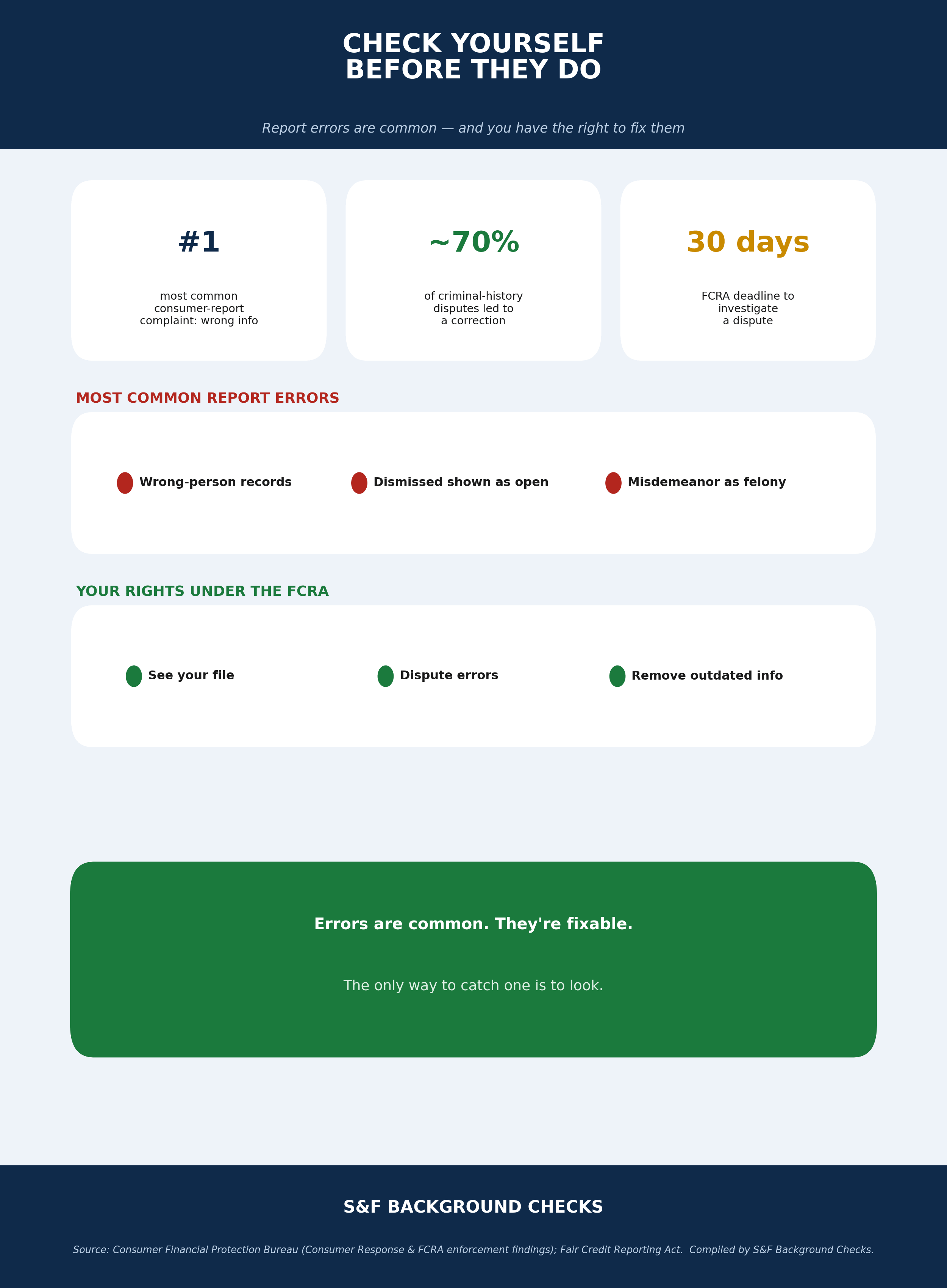
A few figures worth keeping in mind:
Read those together and the message is simple: errors are common, they're fixable, and the only way to catch one is to look.
How do I run a background check on myself? Gather your full legal name, date of birth, SSN, and address history, then pull your report — either free through state and county records, or instantly through a professional self-check anchored to your verified identity. Then read it carefully and fix anything wrong.
Does running a background check on myself hurt my credit? No. Checking your own records is a personal request, not a creditor inquiry. It has no effect on your credit score and creates no employer-visible record.
Will an employer know I checked my own background? No. A self-check is private. It doesn't notify employers or landlords and doesn't appear in any third-party inquiry system.
What should I do if I find an error on my report? Document it, gather supporting paperwork, and file a formal dispute. Under the FCRA the agency must investigate, generally within 30 days, and correct or remove anything it can't verify.
Can I get an accurate record removed from my background check? Sometimes. Many records are eligible for expungement or sealing under state law, and free university law clinics can help you petition. Accurate records that have aged past their reporting window can also be disputed as non-reportable.
How often should I run a background check on myself? Before any major application, after moving to a new state, after any identity-theft incident, and ideally once a year as routine records hygiene.
Here's the bottom line.
You can't manage what you've never looked at. And right now, the most likely scenario is that other people know more about your record than you do — errors and all.
Running a background check on yourself fixes that imbalance in a few minutes. You see what an employer or landlord would see, you separate the real issues from the noise, and you fix what needs fixing while you still have time.
S&F Background Checks makes that self-audit fast, private, and affordable — so the next time someone pulls your record, there are no surprises waiting.
Don't wait to find out the hard way. Look first.